
Review - GRIDbeat!
Developer: Ridiculous Games
Publisher: Acclaim Inc
Platforms: PC via Steam, Steam Deck, Nintendo Switch, Nintendo Switch 2
Reviewed on: Steam Deck
When all else fails, the beat is everything. Music and rhythm games have stuck to a familiar formula for quite some time now, especially since the days of Guitar Hero and Rock Band. Players hit the notes and keep going. There comes a time when the formula changes and a game releases that breaks the mold apart, such as Just Shapes and Beats by Berzerk Studio. A game comes and rethinks what a genre can do and becomes revolutionary in its design and gameplay. I'm pleased to say GRIDbeat! is one of those games.
Infusing puzzle-solving with dungeon-crawling, GRIDbeat! dazzles with its retro-inspired visuals and amazes with its beat-to-beat gameplay, where staying in sync is everything. It strings together elements from other genres, with music at its center, to create an unforgettable musical experience, even if the dancing can be a little off at times.

Welcome to the Grid
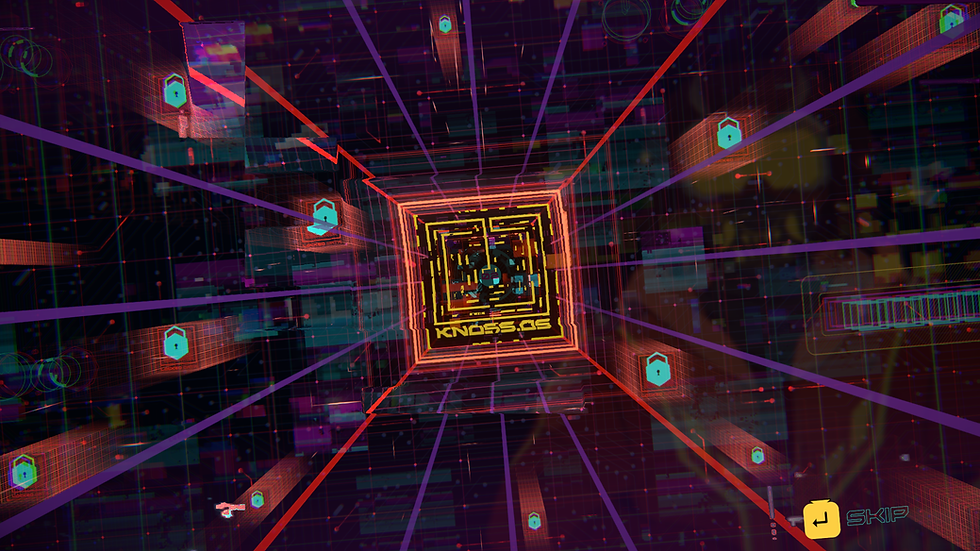
At a lone arcade in a mysterious city, a lone hacker goes on his biggest mission yet. He infiltrates the megaconglomerate Knoss.OS. With its heavily fortified network, Knoss.OS participates in various activities across the planet. The hacker has his mission: Get essential information and make off with a payday where they won't have to worry about anything for the rest of their lives. However, things go wrong.
Trapped in the mainframe, the hacker is surrounded by deadly foes, Cyber bosses, and a labyrinth of digital mazes. There is only one way out, and that is to follow the rhythm and feel the beat. Using the music beat, the hacker navigates the deadly obstacles of the mainframe. One move off-beat and the dance is over for good. This is the setup for GRIDbeat!

Hack the Planet
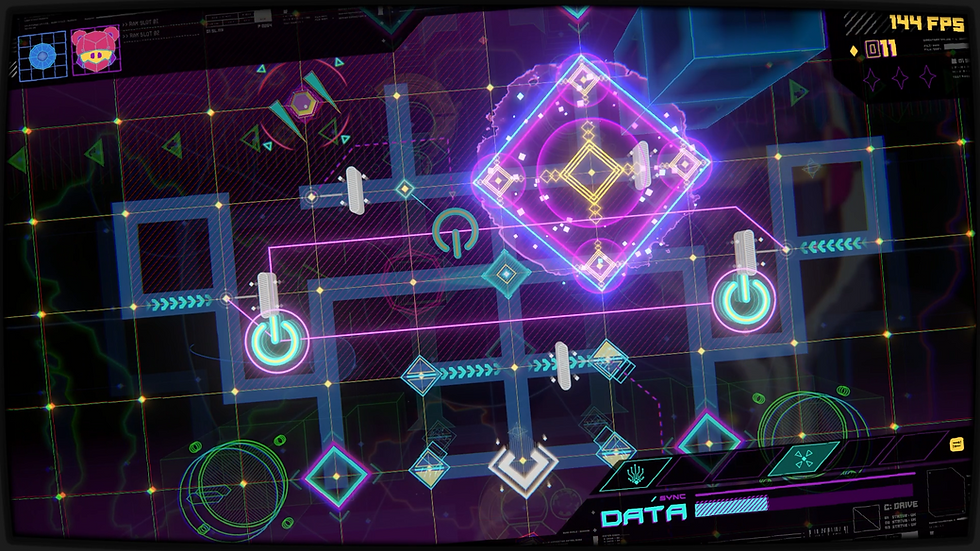
GRIDbeat! is a dungeon-crawling, puzzle-solving music rhythm game. As the hacker, players navigate digital labyrinths to locate an exit and eventually make their way out of the system. The goal of each level is to survive. Each level is laden with traps, obstacles, enemies, and bosses, all requiring their own logic to figure out and overcome. Players are represented as a digital diamond on the screen. The goal of each level is to make it to the end, collecting bits for currency along the way. A digital assistant named Dot assists players on every leg of the journey.
Players have two important bars in GRIDbeat!: The sync bar and the data bar. The sync bar shows how in sync players are with the music. The higher the bar, the better the sync. It can be said that the sync bar acts as a defensive barrier to the Data bar. The data bar is the health bar. Data is lost to enemy fire, bouncing into firewalls, or missing too many syncs. When the data bar goes to zero, it's game over, and the level needs to be restarted.

A Path Forward
GRIDbeat! starts easy, introducing players to a simple dance beat and the game's movement. Soon, small puzzles make their way through, such as opening doors and bypassing walls. Small nodes are on the path and must be hit to the beat to activate and unlock. Just as players get the hang of it, enemies are introduced. This is a fortified data fortress, and they aren't going to let you out easily.
The levels are surprisingly layered, filled with rotating walls, warp gates, elevators, and other obstacles. Players use warps to zip through levels and elevator gates to go deeper into levels. Some levels introduce their own unique challenges. One level may have a format wipe, which is a slow-moving wall of digital fire that consumes the level, with players having to race to the end. Another level introduces the Mino.taur, which is a bull that chases the player. A thief virus robs players of their data and has to be navigated stealthily. GRIDbeat! introduces various inventive mechanics.
Show Me Your Moves
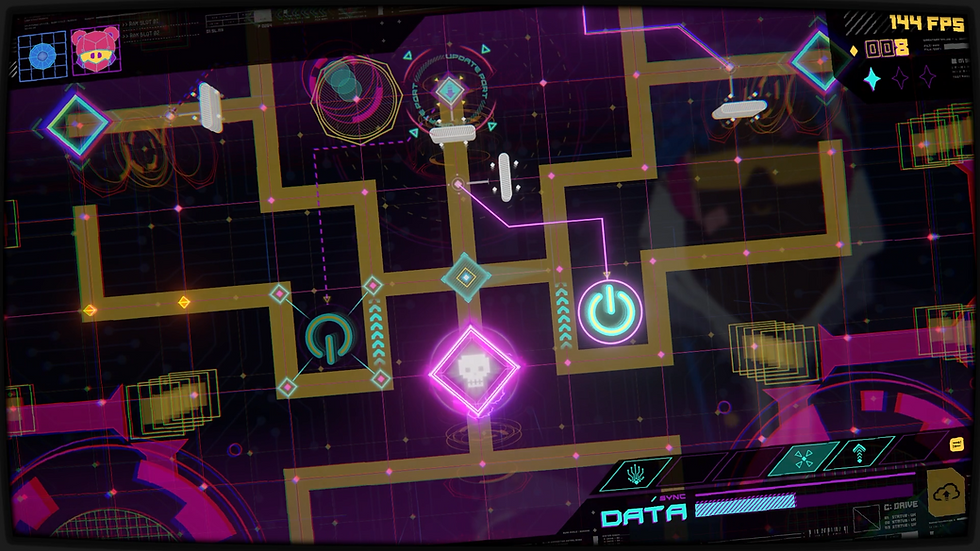
Turrets are introduced, and they become the first of many deadly foes facing players. The turrets fire on the player, causing significant damage if caught in the crossfire. They can be dodged, but when movement is on a fixed path, dodging their fire can be a tricky affair. Other enemies, like enemy cannons and mines, are introduced. These attacks damage a wide field and can be devastating if caught in the blast radius. Listening to the beat is one of the few defenses to counter this.
Some of the obstacles don't involve opening doors and dodging fire, but instead opening firewalls. Some firewalls are simple. Holding the trigger button unlocks a hacking mode, and holding any button on the D-pad has a quick puzzle that pops the firewall and unlocks the path forward. Some do have a minigame with button prompts as well. However, some of the more challenging firewalls, like Black Ice, require unlocking ports, which can overclock the player and defeat the firewall. Overclocks are unlocked during the level, but unlocking data ports, which the game introduces steadily as levels progress.
A Music Library
While GRIDbeat! takes place on fixed paths, and exploration is encouraged. Finding emails reveals more of the story and the activities that Knoss.OS is up to. Finding data ports unlocks more data to heal. Another unlock reveals backups, which act as something between a checkpoint and an extra life. If players have a backup, they can die and start right back where they started. However, these backups are few and far between. I found myself dying at the very end of the level, and without a backup, I had to restart. These moments were a little painful to the massive fun I was otherwise having.
Exploration also allows for collecting bits, which can be used as currency to unlock special abilities. Players can lay a trap that can trap a pursuing program. Another power-up allows a slash to eliminate enemies as well. Finding secretive collectible superbits is also a goal players can strive for, especially if they want to complete the game's 63 achievements.
A Challenger Approaches
Finally, there are the Cyber.Mind bosses. These larger-than-life enemies fill the screen with their presence and require their own puzzle to figure out and successfully defeat. The music charges up and gets incredibly intense, and the enemy throws everything at the player. These bosses range from military A.I. to defensive Daemons to even a virus in a USB stick. These levels are a blast, but they do require being clever and using the game's mechanics. One boss, known as The Kernel, gave me a hard time. It turns out, I had to trick the cannons into destroying gun turrets, which is a mechanic the game introduced me to in an earlier level.
Playing GRIDbeat! is incredibly exciting, energetically charged, and a whole dancefloor of fun! I found myself in a zenlike state navigating through each level, and soon, I wasn't thinking about staying in sync too much but moving with the music and really feeling the vibe that it's generating. One track had female vocals, and I got really into the level navigation and puzzle-solving aspects. Every moment feels amazing. Every enemy outsmarted or downed felt like a victory. Taking on the big Cyber.Mind bosses were always a big highlight.

Real User Power
GRIDbeat! is also very welcoming for players to just have fun. There are calibration and difficulty settings to make the game easier or harder, depending on what players wish for. The game works with players to create a fun experience; it never feels oppressive or too much. Some rhythm games demand quantum reflexes from the player, but with GRIDbeat!, the fun is in the movement, the gameplay, and the game understands that.
Visually, GRIDbeat! is stunning. The game is clearly inspired by the retro-computer visual systems established in 1982's TRON. Everything has a low-resolution, abstract, and minimalist look to things, but then there are amazing polygonally designed bosses. Everything feels unique and distinct, though I feel it could have gone a bit stronger on some levels. One series of levels takes place inside a USB, and it did feel a little too much like the rest of the game visually. Changing the colors or adding other designs to it would have made it feel more distinct.
The music is sharp, ranging from synthwave to vaporwave, all the way to electronic, dance, and funk. GRIDbeat! is certainly a game that is worth playing with headphones on or with full volume on your Switch or Steam Deck. Outside of the main campaign are challenge levels and special guest levels with featured music artists. One such example was a unique level featuring music from Steve Aoki.
Feel the GRIDbeat!
GRIDbeat! isn't perfect. I had some control difficulties with my time in the game. When knocking down firewalls, I'd hold the trigger and d-pad button, which is required, and the hacking would cancel midway through, despite not letting go of the button. I'm not sure if it was my Steam Deck or perhaps the control input in the gam. Additionally, a few levels can get disorienting, and I found myself lost a bit, especially with the warp gates. A guide of some sort would help. These are small blemishes to an otherwise great game.
GRIDbeat! is a fantastic, futuristic music rhythm experience. Its incredible array of retro-inspired visuals, sharp fusion of gameplay aspects, all centered around a strong music core, make this one a true winner! Feel it in your heart and soul and step onto the grid. The only way out is through the thrills of the GRIDbeat!
GRIDBEAT! IS HIGHLY RECOMMENDED
A review key was provided for the purposes of review.


Wow, I loved your insights on GRIDbeat! It's fascinating how you highlighted its multiplayer features.