
Interview with Seishi Irimajiri and Achabox of Acrobatic Chirimenjako, Developers Behind Schrödinger’s Call
Revealed during the Woman-Led Games Showcase, Schrödinger's Call made waves for its engrossing, theatrical storytelling, compelling visuals, and deep narrative. Featuring a gothic storybook visual style, the visual novel invites players to embark on a tale of grief, connection, and hope.
With the game now on Nintendo Switch and Steam, I had the opportunity to speak with Seishi Irimajiri and Achabox of Acrobatic Chirimenjako, part of the three-person development team responsible for making Schrödinger’s Call. They shared insights into making the game and what led them to create this exciting visual novel.
Contributors:
Seishi Irimajiri - Main scenario | Program | Music | Video
Achabox - Director | Art

For those who are unfamiliar, what is Schrödinger’s Call?
Seishi Irimajiri
Schrödinger's Call is a story-driven adventure game set in a world where humanity has vanished. As Mary, the last person left to answer the phone, you receive calls from souls trapped between life and death. Listen to their unfinished stories, uncover their regrets, and help them find peace at last.

Why call the game that name? What is the meaning?
Seishi Irimajiri
There are two main reasons.
First, a phone call cannot exist without both a listener and a speaker. While on the phone, the listener pays close attention to the speaker's words, sometimes responding with empathy and other times not. Depending on those responses, the speaker’s attitude changes. "Schrödinger's cat" originally stems from a thought experiment in quantum mechanics, which suggests that the life-or-death state of a cat in a box remains uncertain until the exact moment you observe it. I integrated this concept because this idea—that the outcome depends entirely on the observer—felt just like responding to a phone call.
The second reason is about the exact moment a phone rings. Unlike modern smartphones, older phones gave you no way of knowing who was calling beforehand. Of course, once you pick it up, you instantly know who it is. However, I once had this illusion that before you actually answer—while the phone is still ringing—the caller's identity hasn't actually been decided yet. I found this idea to be incredibly intriguing, much like Schrödinger's cat, and that is why I chose to bring it into Schrödinger's Call.
There are a few other meanings hidden within the title, but I think you'll discover them for yourself by the time you reach the end of the game. I hope you'll enjoy thinking about what "Schrödinger's Call" truly means as you experience the story.

The visual style is absolutely impressive and breathtaking. Tell us more about why you chose this style and how it was made?
Seishi Irimajiri
Regarding the visuals, we decided right from the start of development to base them on a monochrome palette. Regardless of country or culture, the combination of black and white inherently evokes images of life and death.
While focusing mainly on hand-drawn illustrations and collage art by our director, Achabox, we also wanted to create a world that feels nostalgic and difficult to place in any specific era. We intentionally chose to use old-fashioned telephones because they leave room for imagination—before answering, you can only wonder who might be on the other end of the line.
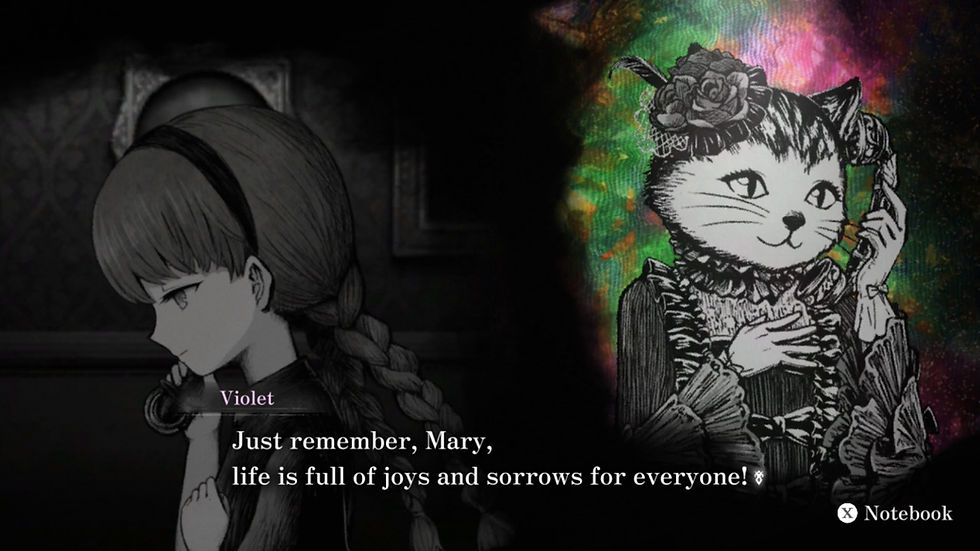
Although the game is primarily presented in monochrome, moments of heightened emotion are expressed through vivid, psychedelic colors. We wanted the visuals to become more dramatic as the characters' emotions intensify, allowing the player's feelings to rise alongside them.
We also established a special agreement with a creative asset platform to download and use a variety of materials. However, rather than using them as they were, we processed them into a painterly style using a specialized app called BrushStrokePro before implementing them into the game. This app uses a unique algorithm to transform photos and videos into painted artwork. It was originally available only on iPhone, but I actually contacted the developers in California and advocated for a Mac-compatible version. Much like the process of layering a real oil painting, we repeatedly transformed various photos and videos into oil-painting-style images, blended them together, and reprocessed them multiple times to create the final visual style of the game.

Why anthropomorphic characters and not humans?
Achabox
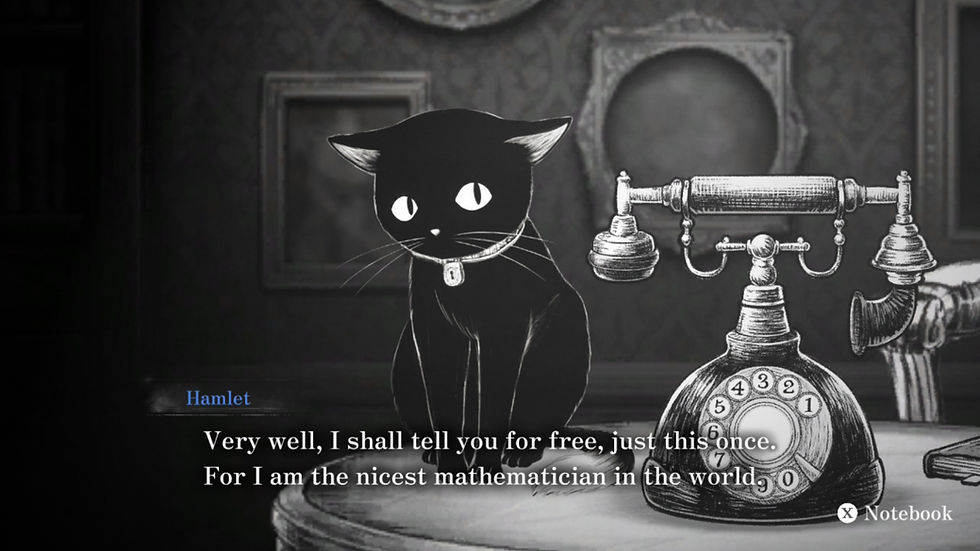
The people on the other end of the phone are initially strangers to both Mary and the player—individuals imagined only through their voices. By portraying them as anthropomorphic animals, we wanted to capture that feeling of imagining who someone is before truly knowing them. We also chose to make Mary the only human character in the game, which helps emphasize her unique role as the world's last conversation partner, someone who listens and connects with others.
If we realistically depict sad regrets or the raw terror of death using human forms, the story can become too graphic, breaking the player's immersion. However, by filtering these themes through animal forms that evoke the gentle texture of a picture book—offering a fabled abstraction—we managed to create a sense of "empty space." This allows players to project their own loved ones onto the characters without any bias.

I understand the game came from the isolation of the COVID pandemic and your personal experience. The phone calls you received were central to the development of Schrödinger’s Call. Please tell us more about those emotions and experiences, and how they are implemented into Schrödinger’s Call.
Achabox
I first came up with the idea for this game when the entire world was in the midst of the COVID-19 pandemic. At the time, I was going through a series of deeply distressing personal events, including the passing of my grandmother. Ordinarily, one would process that kind of grief by meeting people and exchanging comforting words in person, but due to the lockdowns and stay-at-home orders, that simply wasn't possible.
Even so, there was a desperate, lingering need inside me that kept crying out, 'I just want someone to listen to me.' After some time, through platforms like Discord and Zoom, I started getting more opportunities to join online communities where I could talk not just with friends, but also with people I had never met before. Taking a leap of faith, I opened up about what I was struggling with. To my surprise, I discovered that these complete strangers were carrying the exact same pain and inner conflicts that I was.
From that vulnerability, new bonds were born, and I personally found immense comfort and salvation. 'Even if we are physically far apart, we can still touch and comfort someone’s heart through a telephone receiver.'──This very experience was the ultimate catalyst that made me want to create a game centered around phone calls.

Why a visual novel?
Seishi Irimajiri
To be honest, we did not set out to make a visual novel from the beginning. We created many different prototypes and explored various gameplay styles, constantly asking ourselves what kind of game could best express the central theme of Schrödinger's Call: being there for someone and comforting their heart.
Through that process, we discovered that a visual novel was the perfect genre for combining our own music, visuals, text, and programming into a single experience capable of creating deep immersion. Among all game genres, we believe the visual novel is uniquely suited to expressing a story exactly as its creators intend. That is how Schrödinger's Call gradually took shape as the game it is today.
Tell us about the writing and how you are able to convey your experiences into the narrative of Schrödinger’s Call
Seishi Irimajiri
Rather than drawing strictly from my own experiences, I listed several universal struggles that anyone might face in life and wove them into the themes of each chapter—such as family dynamics, best friends, and romantic partners. I then imagined what kind of people and what type of phone calls would best evoke each theme, and drafted the script based on those interactions.
From there, I focused on how to guide the players through these phone conversations and uncover them step-by-step through Mary, considering what kind of experience would be most impactful for the player. For most scenes, I established the themes and concepts first, and then worked backward to figure out how to realize them, meticulously crafting the final scenario.

How did you come up with the concept of the Moon falling ?
Seishi Irimajiri
The motif of the moon falling was inspired by Lars von Trier's film Melancholia. Beyond that, I was trying to think of what the most impactful and unpredictable event shared by all of humanity could be, and that's how I decided on the moon falling. Furthermore, throughout the game, I frequently use motifs related to circles, cycles, spheres, and rings—such as telephone dials, phenakistoscopes, and clocks. The idea of the moon was also born from that thematic focus.

What do you hope for players of Schrödinger’s Call to experience?
Seishi Irimajiri
Nothing would make us happier than if, after finishing the game, players find themselves thinking about the voices of the people they cherish, or perhaps the voices of those they can no longer hear.
We hope the game encourages players to step away for a moment from the noise and distractions of modern life, and to imagine the unseen person on the other end of the receiver. To listen carefully, to empathize, and to simply be there for someone who may be carrying loneliness in their heart.
If that experience remains with players as a bittersweet yet comforting memory, we would be truly grateful.
Is there anything you'd like to say for our audience of veteran gamers?
Seishi Irimajiri
Unlike other games, Schrödinger's Call doesn't have rules centered around defeating opponents or overcoming competition. Instead, its purpose is to save the hearts of others through a narrative where you listen to their stories. At the same time, it carries a core theme that by saving someone else, you are ultimately saving yourself. If you are looking to play a game themed around salvation and connection, we would love for you to give it a try. Finally, we would like to express our deepest gratitude to Stack Up for showing such a meaningful interest in our game. Thank you so much.
Thank you for your time, and congratulations on the launch! -Roberto A. Nieves
Schrödinger’s Call is out now on PC via Steam and the Nintendo Switch!
Comments